Showing posts with label H.P Lovecraft. Show all posts

Monday, May 7, 2012

REVIEW: Mansions of Madness

Mansions of Madness
Introduction: The group and I got together last week to try out Fantasy Flights, Mansions of Madness. From the product description:

During each game, investigator players explore an eerie location in the hopes of solving a mystery before it’s too late. Investigators win or lose as a team, and need to keep their wits about them to find the artifacts, weapons, and clues needed to stop the keeper’s diabolical plot. The keeper’s goal is to fulfill an evil scheme, which can range from driving the investigators insane to bringing about the end of the world. The keeper’s weapons are fear, paranoia... and terrifying monsters. Can a handful of brave investigators uncover the truth in time, or will the wicked plans of the keeper come to fruition? 

It is a game for 2-5 players that plays in 2 to 3 hours. Our game lasted 2.5 hours.

The Skinny: Similar to Arkahm Horror in the sense that players take on the role of Investigators, the addition of a competing player, as the Keeper, gives the game an odd, yet cool feel of being a cooperative game, yet being competitive at the same time.  MoM is a Lovecraft Mythos inspired board game.

The game comes with several scenarios and there are expansions available to add more. Many of them are print on demand.

The Good: The four of us had a blast with this game, and that is the most important judgement of any game. It is very handsome, and the plastic figures included with the game would work well with Arkham Horror as well (which I reviewed here), Call of Cthulhu, and/or your favorite fantasy game. As to how lovely it is, I will let my shoddy pictures, taken from my game table, speak for the game.

The Bad: MoM is a tile based game and as with any tile based game, the tiles slide around easily. Our Keeper solved this with an inexpensive mat, the kind you line your kitchen cabinets with to keep dishes off the bottom of the cabinets themselves. This worked splendidly, and I plan on stealing his idea the next time I play a tile based game such as Settlers of Catan.

The Ugly: I have nothing "ugly" to say about this game. It really is that good!

Summary: This is a great game; especially if your are a H.P. Lovecraft/Mythos enthusiast like me. Buy it. Play it. I guarantee it will not collect dust on your shelf.


Saturday, March 31, 2012

Random Encounter 3: The Secret of Kopao Cave

This is a location based encounter. It is inspired by the article "Last of the Cave People" by Mark Jenkins in the February 2012 issue of National Geographic. In the article, Jenkins and photographer Amy Toensing follow the Meakambut , the last of the nomadic cave dwellers still residing in Papua New Guinea. It is an interesting article and I encourage you to seek it out; however, as a disclaimer in this encounter I portray the nomadic cave dwellers as antagonists. This is fantasy and in no way am I proposing that the Meakambut are a savage people. In the article, Jenkins does make mention that the Meakambut do believe, and are terrified of, sorcery. At one point, he fears for his safety as a member of the Meakambut led him to a cave sacred to them called Kopao and told him the secret of the cave. That night John, the member of the Meakambut tribe that led Jenkins to Kopao and told him the secret of the cave, had terrible dreams. In his dreams, his ancestors were angry at him for telling the Meakambut's secrets to a white man. That morning, a member of the tribe fell terribly ill with pneumonia. Jenkins feared that if the ill member were to die, he would be blamed. That story is the kernel for this random encounter.

This encounter takes place in a jungle environment. It can be run as an outdoor adventure, perhaps a hex or two, or several must be explored as the exact location of Kopao Cave is not known. Random encounters with jungle beasts are possible. I myself am always fond of Robert E. Howard inspired giant snakes, not to mention savage apes. Of course the less mundane critters from your favorite monster manual could always be added. The tribes that live in the area do not welcome outsiders. The subsist from hunting and gathering. The intrusion of outsiders can disrupt their hunting and gathering by either killing game or scaring it away. In either case, they are very protective and will deal with all outsiders. They prefer not to attack openly; instead, they will rely upon their superior knowledge of the area and set traps for the party, or attempt to lead them into dangerous areas. If they must attack, they prefer to do so from high up in the jungle foliage. They are experts at camouflage, and their weapons of choice are poisoned tipped javelins and darts. If forced into a face to face melee, they wear little armor, but do make use of small wooden shields and long curved knives of bone (which also may be poisoned).

The characters have heard stories whispered that amongst the nomadic jungle tribes, there is a sacred cave with a secret. If time and resources are spent discovering what this secret is, they will find vague creation myths. Basically, the tribes of the area believe that they were "birthed" from Kopao cave and that it is a conduit which leads directly to their gods. They do not frequently visit the cave, but do take the skulls of honored members of their tribes there to be put to rest. This is an honor. Rumor is, that these honored members (chiefs and great warriors and hunters) are put to rest with valuable treasures. What these treasures might be is up to the DM, but rumors of gold and relics should be discovered to entice the players to find Kopao cave.

Kopao cave should not be easy to find. Much exploring must be done. Even when the location is discovered, the party must make a dangerous climb up a vertical face that even thieves will have a hard time with without the proper equipment. Of course the tribes of the area set traps for the unwary as safe guards.

Entering Kopao cave, the players hunch under a low overhang that only halflings will not find uncomfortable to enter. Within, they are greeted by a gantlet of skulls, most of which are green with age, but others appear more recent. Past the skulls are numerous hand prints stenciled in blood. The hand prints are the first indication of the true secret of Kopao cave. Once a year, the tribes select one of their best hunters as a sacrifice. He is brought to the cave. As an honor, he is cut, then dipping his hand into a saucer of his own blood, he makes his mark amongst those of the past sacrifices. This honor completed, the ritual begins and he is sacrificed to appease the dwellers of the cave. There are indeed treasures left beyond the hand prints, these too are left to appease the dweller of the cave. Here the players will find large feathers, the hollow avian bones of which are full of fine gold dust and capped with a gum made from the sap of trees. There are also garments spun from fine fabrics and favored weapons, some of which are magical. These are there for the taking, if the players can deal with the dweller first.

What is the dweller? Think Lovecraftian. Kopao cave is portal that leads to another dimension. Luckily, it is weak and the dweller can only enter from its dimension no farther then the cave. There is a large crack in the ceiling. It is about twenty feet long, and three hand spans wide. From this crack, an odor is noted. An odor reminiscent of rotten fish, but not overpowering. It is as if dead fish were stuffed into the crack, left for a few weeks, then removed a week ago. Magic-users and elves get an uneasy feeling in close proximity to the crack. Their stomachs feel queasy and they find the hairs on the nape of their necks stand up, they may also get goose bumps. The closer one gets to the crack, the cooler the air temperature becomes. Standing right beneath it, the air is so cool, one shivers. A darkness in noticed within the crack. Torches and lanterns will not illuminate it, a light spell does not even penetrate it. Voices are heard from the within the crack. Whispers in a language that none can fathom. The hushed whisper increases into a present drone. Finally, a tentacle slithers from the crack, followed by another. That is when the darkness radiates from the crack acting as a Darkness spell.

Now is when the characters, if they are smart, run. I use insanity rules in my games, and would require sanity checks. If they stick around to fight it out, they most likely will perish. They should be able to grab some treasure and run before all hell breaks loose.

Wednesday, February 22, 2012

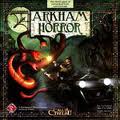
REVIEW: Arkham Horror - A Cooperative Board Game

My group's recent nerdgasm has been delivered via Fantasy Flight's Arkham Horror board game. As with all Fantasy Flight games, it is a work of art. The box is heavy duty, the game pieces are built to last, the art work is top-notch and the flavor text associated with the game is prime.

It is a game designed for one to eight players, with four being optimal, in my best-guess opinion; however, we have been playing with three and have found it challenging, but not unmanageable; as a matter-of-fact, we have won both games we've played. I do feel that a fourth player would be better for game balance, but more then four, again my opinion only, may get cumbersome. I am curious to pick up my own copy and give solo play a try, but suspect the success rate of solo play would be about on par with my success rate with most Tunnels and Trolls solo adventures, in other words, non-existent.

The basic gist of the game is this: players take the role of an Investigator. This investigator can be assigned randomly, or selected. We normally select the investigator of our choice. Game play is broken into several turns which are played until either a victory condition is met, or the Ancient One awakes, which often leads to defeat. The Ancient One is either selected randomly at game set-up or chosen. Again, we choose our Ancient One. If the players are defeated, the Ancient One in play devours/destroys the city of Arkham.

Each turn is broken into five phases:

1. Upkeep, in which the players refresh abilities of their investigators

2. Movement, self explanatory, players move their investigators about the game board.

3. Arkham Encounters, in this stage any investigators in the city might have an encounter. Encounters can be combat in nature with monsters, or skill checks that may lead to a terrible fate or possible bonus.

4. Other World Encounters, this stage is run much the same as the Arkham Encounters phase, but takes place in the other worlds that open via gates.

5. Mythos. In this stage, a mythos card is drawn and its effects are put into play. This often includes the opening of another gate, which spawns monsters and brings the Ancient One that much closer to awakening. There are several other effects as well, too numerous to go into for the purpose of a quick and dirty review.

We have now played through it twice, and are eager for a third helping. When deciding upon a new game for my group and myself, one of my chief concerns of the game in question is, "is there replay value"? In the case of Arkham Horror, I whole heartedly say yes there is. In the base game alone, there are several choices of investigators to select from, each one has strengths and weakness that make each game a new experience. Also, there are several options of Ancient Ones as well, and each Ancient One brings its own changes to each game. Of course Fantasy Flight also has available several expansions that add new elements to the base game itself, such as more investigators, Ancient Ones and optional rules. All-in-all, Arkham Horror is well supported by Fantasy Flight and it appears that they intend to do so for some time. Support, especially if it appears long term, is another factor I look for in a game prior to investing, as to be honest, the average, quality board game will run a geek anywhere from $15 to nearly $100. That's a lot of rupees.

What impresses me most with the game is the cooperative way in which it is played. For those that do not know, a cooperative game means that the players, in this case one to eight, cooperate together to beat the game. There is a definite "us versus them" mentality.

Strangely, we had difficulties with cooperative play at first. It seems odd that we would as in the past, we have played lots of roleplaying games, which are cooperative by nature, even if that cooperative nature is only amongst the players versus the game master.

I suspect that difficulties with cooperative play in our group stem from our long history of playing board games together. One of our "go-to" games is Zombies! If you have never played then take my word for it, it is a very cut-throat, non-cooperative game. My group and I have developed a mentality of "if I can't win, then I will screw over as many of you bozos as I can"!

This attitude will not work in a cooperative game; especially not with Arkham Horror. As I stated, we have played twice and we have beaten the game both times. From reviews that I've read, our 100% success rate is unusual. Most players find a success rate of closer to 20% on average when playing Arkham Horror. We have done a careful review of the rules to make sure we aren't cheating, and our conclusion is that while we've made some minor mistakes, mostly during our first outing, we have not been bending the rules nor breaking any that would lead to our sound victory record. It appears, we are either just that damn good, or very lucky our first two outings out.

The negatives of the game are hard to find. The chief complaint I believe would have to be long game play. Our first game took an excess of five hours; however, our second game was finished in just under four hours. I would state that average game play is in the four hour range. Another concern is a long set up time. It has taken us about 15 minutes both times to set up the play area and this is common with many of Fantasy Flight's games due to all the chits and pieces involved.

The only other complaint, and I wouldn't even call it a complaint -- more like an observation, is that the Mythos of the game is derived from the Cthulhu Mythos developed by August Derleth and not H.P. Lovecraft. As I said though, this is not a complaint, merely an observation. I am solidly in the S.T. Joshi camp of Lovecraft fans and am not a supporter of the mythos as Derleth developed it, but I can put that aside for a chance to play a great game.

Arkham Horror is a great game.